A silencer, a filter or a manifold can be perfectly sealed and still be scrap, because the thing that matters is how freely air passes through it. Flow testing measures restriction rather than leakage, and it catches the blocked baffle, the collapsed media and the wrong internal that a leak test will happily pass.
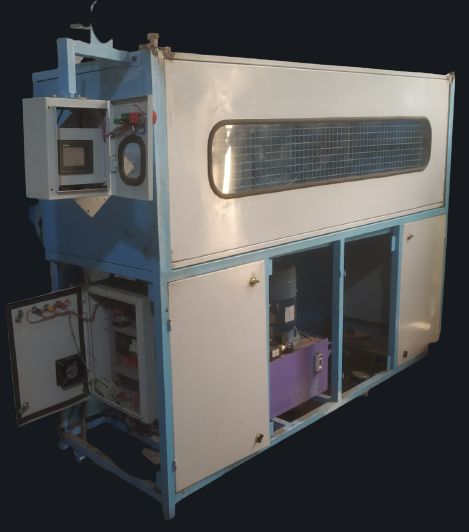
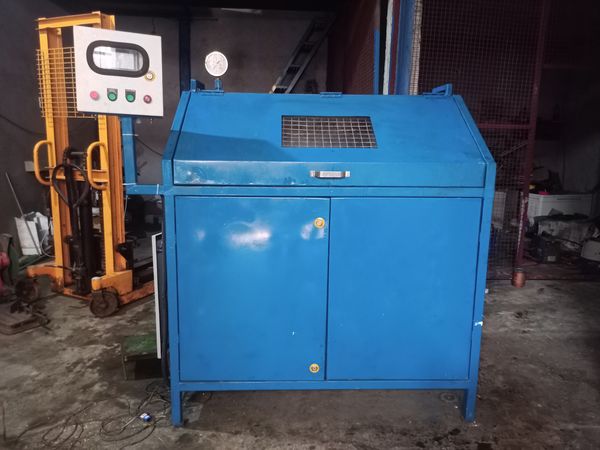

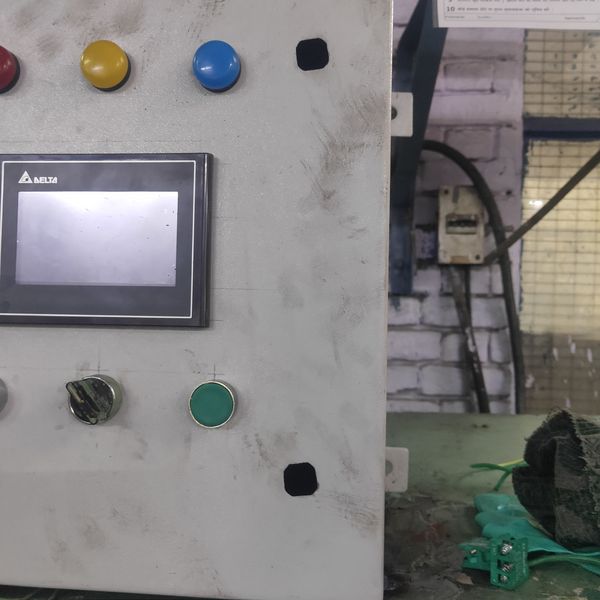
Most test benches in a factory ask whether a component holds pressure. An air flow testing machine asks the opposite: how freely does air pass through it? For a silencer, a filter, a manifold, an air duct or an intake, the acceptance criterion is not sealing — it is restriction, usually expressed as back pressure at a given flow rate, or flow achieved at a given pressure.
These are the defects it catches, and none of them fail a leak test: a baffle welded in the wrong position, a partly blocked internal, filter media that collapsed during assembly, a perforated tube crushed in handling, the wrong internal fitted to the right shell, or a wire mesh that is a grade coarser than the drawing.
A silencer that is too free-flowing is as wrong as one that is blocked. Restriction has an upper and a lower limit — too little back pressure usually means the internals are missing or wrong, which is why the verdict is a band and not a maximum.
Exhaust silencers and mufflers, catalytic converter shells and DPF assemblies, air and oil filters, intake manifolds and air boxes, HVAC ducts and diffusers, radiator and intercooler cores, pump and compressor housings, and any component whose drawing carries a pressure-drop or flow specification.
Where the same part also needs a seal check, we combine both on one station — flow test and air leak test in a single cycle, so the part is fixtured once. See our testing machine overview for how the methods sit together.
Flow control, compensation, band judging and logging all come from a control panel built and ferruled in our own Faridabad workshop.
Too free-flowing is as wrong as too restrictive. The verdict is a window, which catches missing and wrong internals.
Master comparison cancels out supply and ambient variation, the same principle that makes differential leak testing repeatable.
Air density moves with temperature and barometric pressure. Without compensation a bench drifts between morning and afternoon.
Fixture sealing designed for your component — a bench that leaks around the part measures the fixture, not the component.
Test flow, acceptance band and compensation stored per part, selected by the operator or read from a barcode.
Flow, back pressure, verdict, operator and timestamp recorded, with SCADA trends where the line needs them.
Photographs from our Faridabad workshop and from customer installations.
air-flow-test-bench.jpgComplete flow test benchair-flow-fixture.jpgSealing fixture with componentair-flow-hmi.jpgHMI flow and back pressureair-flow-silencer.jpgSilencer under testair-flow-panel.jpgPLC control panelair-flow-master.jpgMaster componentFlow benches are sized around the most restrictive part you make, so we work from your acceptance sheet rather than a standard model.
| Parameter | What it covers | Fixed at |
|---|---|---|
| Test point | Flow rate at which back pressure is measured, or vice versa | Enquiry |
| Acceptance band | Upper and lower limits from your drawing | Enquiry |
| Component range | Sizes, connection types and the most restrictive part | Enquiry |
| Air supply | Blower or compressed air, sized for peak demand | Drawing approval |
| Measurement | Flow meter type and range, DP transducer range | Drawing approval |
| Fixture | Sealing, clamping and poka-yoke for each variant | Drawing approval |
| Compensation | Temperature and barometric correction method | GA approval |
| Master | Master part handling and verification frequency | GA approval |
| Data | Fields logged, storage and export format | GA approval |
On a flow bench, any air that escapes around the component instead of through it is measured as if the part were freer-flowing than it is. A small leak at the sealing face makes a blocked silencer read as acceptable — the exact failure you bought the bench to catch.
So the fixture gets the same attention as the instrumentation: sealing faces designed for your component's actual geometry, clamping that repeats, and a daily master check that would reveal a degraded seal before it passes a batch. We prove it at trial by running a deliberately blocked part and a deliberately empty shell, and confirming the bench rejects both.
Leak testing asks whether the component holds pressure. Flow testing asks how freely air passes through it. A silencer with a blocked baffle is perfectly sealed and completely wrong, and only a flow test finds it.
Because too little restriction usually means internals are missing, wrong or damaged. A shell with no baffles flows beautifully and is scrap. The acceptance is a band for that reason.
Air density changes with temperature and barometric pressure. Without compensation, the same part measures differently at 8 am and 3 pm. We compensate the reading and, where accuracy demands it, compare against a master that sees the same conditions.
Yes, and it is usually worth it. The part is fixtured once and the cycle runs both tests in sequence, which removes a handling step and a source of error.
A known-good component is measured at set intervals, typically at shift start, and the result logged. It proves the bench is still reading correctly — and it is the first thing that shows a degraded fixture seal.
Yes. Test point, acceptance band and compensation are stored as recipes per part number, with quick-change fixture inserts and poka-yoke so the wrong variant cannot be tested against the wrong band.
Yes — Delhi NCR, Gurugram, Manesar, Bhiwadi, Ghaziabad, Noida and across India, installed and commissioned by our own engineers.
Share the drawing or a photo on WhatsApp and we will come back with a method, a cycle time and a price.
Please add a phone number or an email so we can reply.
Only a phone number or email is needed. Everything else is optional — the WhatsApp chat opens with your requirement already written, so you can add the rest there.
Want to know more, or ask anything about Air Flow Testing Machine? We reply fast on WhatsApp