Capability pages describe what a company can do. This one lists what it has done — the panels, the machines and the plants that left our workshop, and what each one had to solve. Where a customer has asked us not to name them, we describe the work and leave the name out.
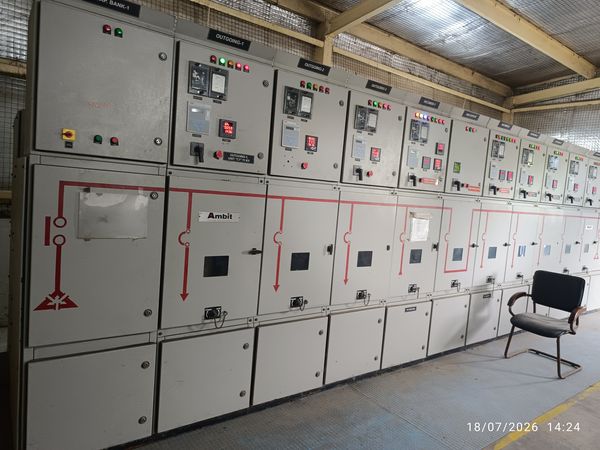
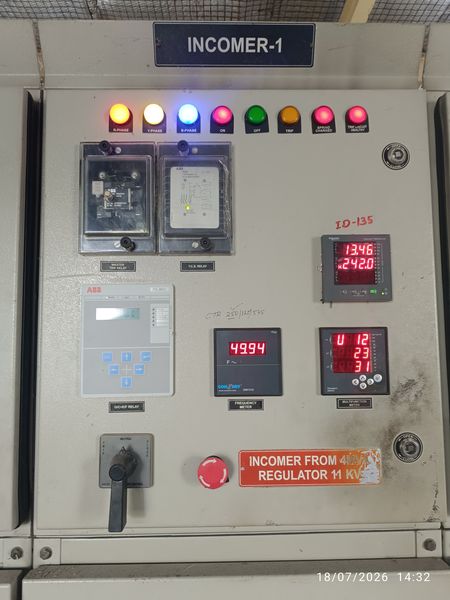
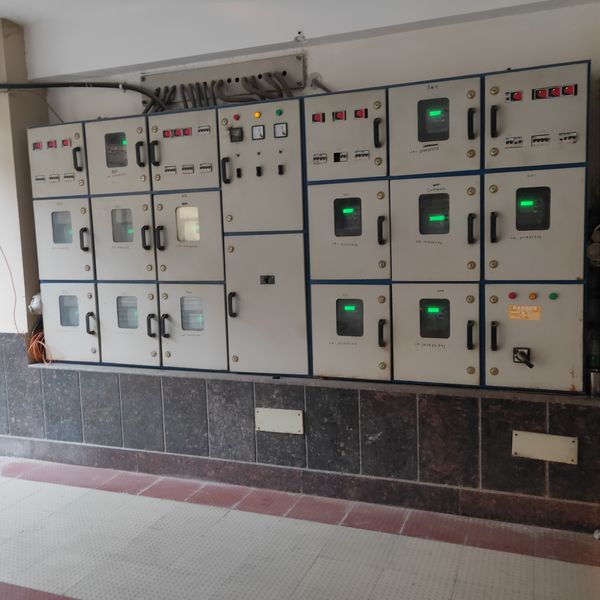
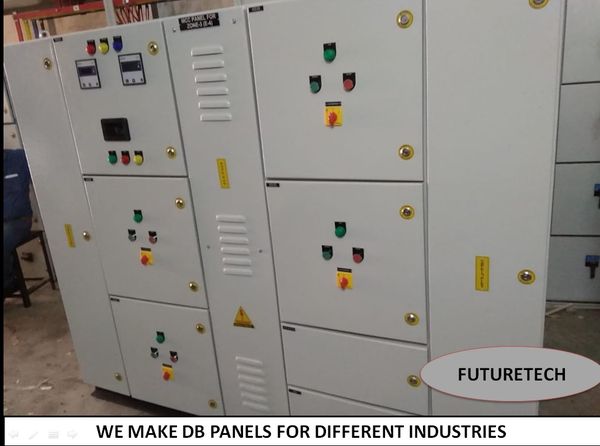
The job: six air handling unit control panels for an institutional HVAC installation, built around YASKAWA GA700 variable frequency drives for 7.5 kW and 11 kW fan motors.
What it had to satisfy: an institutional project with a consultant specification, which meant the GA drawings and control schematics had to be issued and approved before anything was manufactured, and the approved set had to match what was actually built. Multiple panels on one project also meant a common wiring standard across all of them, so that the facilities team inherits six panels that behave the same way rather than six variations.
What was delivered: techno-commercial documentation, GA drawings, control schematics and the panels themselves, wired, ferruled and tested. More on AHU control panels →
The job: joint measurement recording and commissioning certification for a megawatt-scale solar installation, including metering verification.
What it involved: the sort of work that decides whether a large plant is accepted or argued about — verifying the meter, its serial number, its multiplying factor and its opening reading, and producing the JMR and commissioning documentation that the parties actually sign. Getting a multiplying factor wrong on a plant of that size is not a rounding error, it is a dispute.
Why it matters here: most solar contractors can install panels. Far fewer are comfortable in the metering and documentation end of a large plant, which is where our panel and instrumentation background earns its place. More on industrial solar →
The job: a complete control wiring scheme for an ABB Formula AIR FA2C 2000 A air circuit breaker with YU undervoltage release, YC closing coil, YO opening coil and spring charging motor, taken through four revisions to a final approved design.
What made it interesting: the details that decide whether an ACB scheme is reliable or intermittently annoying. Gating the spring charging motor through the breaker's own auxiliary contact gives a natural anti-race delay without adding a timer that becomes another thing to fail. The closing coil path was kept clear of the auxiliary contact because the breaker's internal anti-pumping already handles that function, and duplicating it causes more problems than it solves. Auto and manual paths were separated so that a mode selector actually selects a mode rather than partially overlapping both.
What was delivered: ladder schematics on A4 landscape sheets, revision-controlled, in a form a site electrician can actually follow at two in the morning. More on LT panels and switchgear →
The job: direct-on-line starter panels for air compressor application, quoted with GA drawing and control schematic as part of the offer rather than as something to be worked out after the order.
The point: it is a straightforward panel, and that is exactly why it is here. Most of what a workshop builds is not exotic. The difference between suppliers on ordinary work is whether the drawing comes with the quotation, whether the wiring is ferruled, and whether the panel is tested before it ships. It is the same discipline as the complicated jobs, applied to a simple one.
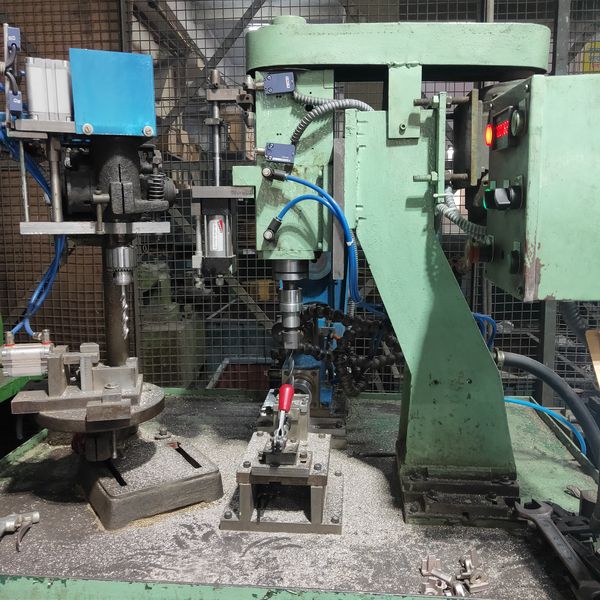
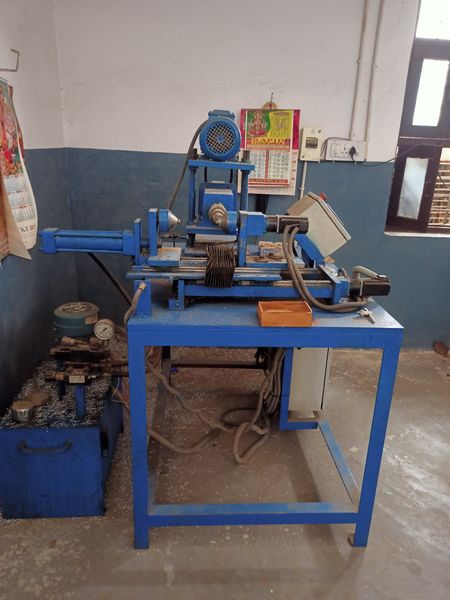
Ongoing work for auto component manufacturers around Faridabad and Delhi NCR: air leak testing machines for machined castings and housings, submersion stations for porosity investigation, monitored press stations with force-displacement records, and drilling and tapping SPM.
The common requirement: every one of these customers is audited by somebody further up the chain, so the machine has to produce a record and not just a verdict. That is the thread running through all our SPM work, and it is why the automation and data side gets as much attention as the mechanics.
Alongside the named projects, the steady work: MCC and PCC panels for factory plant rooms, APFC panels for units fighting demand charges, VFD pump panels, DG synchronizing panels, and solar DC and AC distribution boxes — across the sectors we serve.
Different scales, different sectors, same working method — which is the only reason a list like this is worth reading.
On every one of these, the GA and the schematic were approved before anything was built.
The ACB scheme went through four revisions. That is normal and it is how a design gets right, provided the revisions are tracked.
On the solar commissioning work, the documentation was the deliverable. It is treated that way on smaller jobs too.
A DOL starter panel gets the same drawing, ferruling and testing as a 2000 A scheme.
Every SPM customer is audited by somebody. The machine has to produce evidence that survives that.
Most work is within an hour of the workshop, which is why our engineers can be on your floor the same day.
Photographs from our Faridabad workshop and from customer installations.
project-ahu-panels.jpgAHU panels before dispatchproject-solar-commissioning.jpgSolar plant commissioningproject-acb-panel.jpgACB control panelproject-spm-line.jpgSPM on customer lineproject-mcc-panel.jpgMCC panel installedproject-ga-drawings.jpgGA drawings and schematicsIf you are evaluating us, these are the questions worth asking about any project on this list — and about any supplier.
| Question | What a good answer sounds like |
|---|---|
| Who drew it? | We did, and you approved it before we built anything |
| Who wired it? | Our team, in our workshop, ferruled |
| Who programmed it? | Our team, in the same building as the wiring |
| Was it tested before dispatch? | Yes, with a report, and you could have witnessed it |
| What documentation shipped with it? | Drawings, schedules, backups, spares list, manual |
| Who commissioned it? | Our own engineers |
| Who answers the phone in year three? | The same workshop, with the same drawings |
A fair number of our customers do not want their supplier list published, particularly the auto component manufacturers whose OEM relationships are commercially sensitive. We respect that, so those projects are described by what they had to do rather than by who they were for.
If you are evaluating us seriously and want references, ask. Several customers are happy to speak to a prospective buyer directly, which is worth more than a logo on a page.
Yes. Several are willing to talk to a serious prospective customer about how a job went. Ask us and we will arrange it — it is worth more than any case study we could write.
Many auto component manufacturers treat their supplier list as commercially sensitive, particularly where OEM relationships are involved. We describe the work and leave the name out rather than publish it without permission.
Yes, and the DOL starter panel on this page is here deliberately. Ordinary jobs get the same drawing, ferruling and testing discipline as the complicated ones.
Yes — the IIT Jodhpur AHU work was six panels on one project with a common wiring standard and a single approved drawing set, which is what makes them maintainable afterwards.
Yes, regularly, on building and infrastructure projects where we supply panels to the electrical contractor and work to the consultant specification.
By value, multi-panel institutional and industrial projects. By plant size, commissioning and documentation work on a megawatt-scale solar installation. Tell us your scale and we will tell you honestly whether it suits us.
Share the drawing or a photo on WhatsApp and we will come back with a method, a cycle time and a price.
Please add a phone number or an email so we can reply.
Only a phone number or email is needed. Everything else is optional — the WhatsApp chat opens with your requirement already written, so you can add the rest there.
Want to know more, or ask anything about our projects? We reply fast on WhatsApp