When the hole count goes up and the cycle time goes down, drilling holes one at a time stops working. A multi-spindle drilling machine brings every spindle down together, so the pattern is produced in a single feed — and its accuracy comes from the head and the fixture rather than from repeated setups.
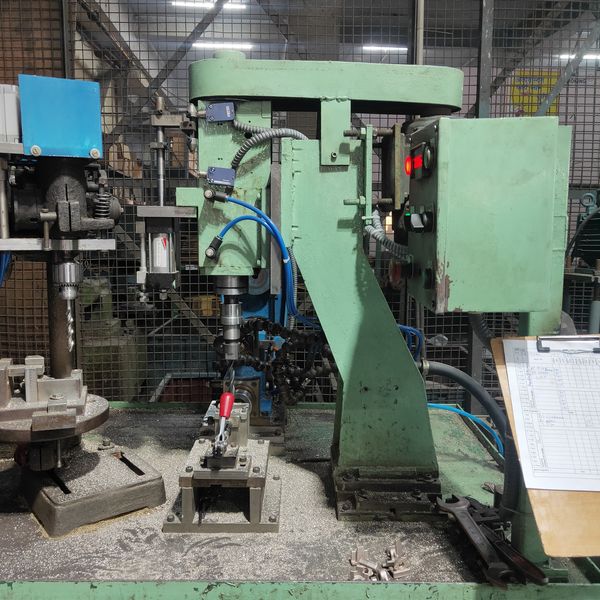
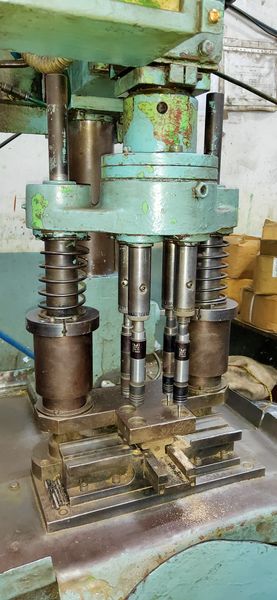
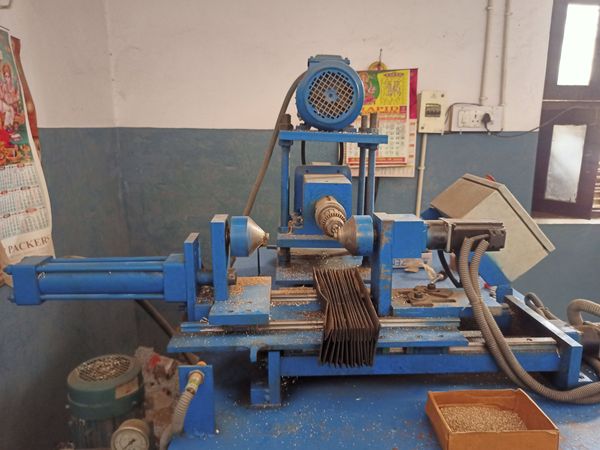
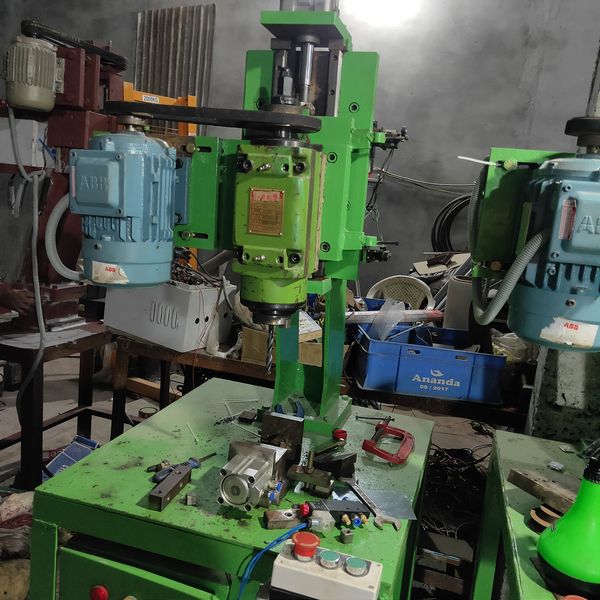
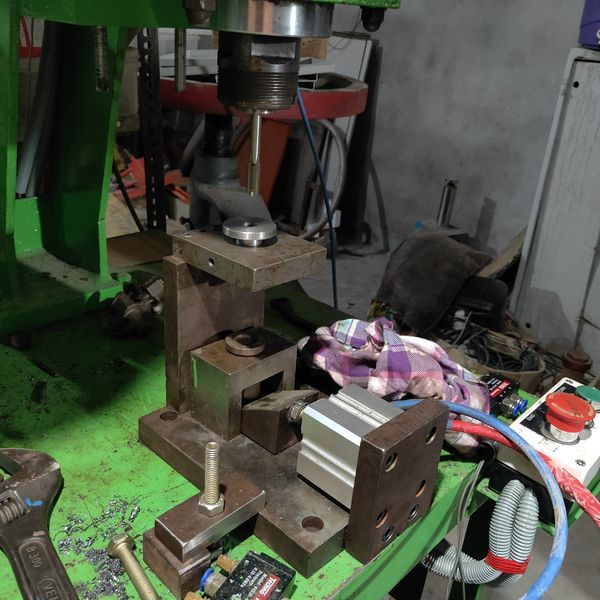
A multi spindle drilling machine carries several drills in one head and brings them all into the work together. Instead of drilling six holes in six operations, the head feeds once and the pattern is finished. The cycle time falls to roughly what a single hole used to take, and the spacing between holes stops depending on how carefully anyone positioned the part.
That second point matters more than the first. In a gang or geared head, the hole positions are fixed by the head casting and the bush plate — machined once, to your drawing. Every part that goes through gets the same pattern because the geometry is built into the machine rather than re-created for each component.
Volume alone does not justify it. What usually does is a hole pattern with a positional tolerance that manual drilling keeps failing, or an assembly downstream that jams when the spacing drifts.
Both put several drills in the work at once, but they suit different jobs.
We advise on which one your job needs from the drawing and the mix of parts you run, rather than fitting whichever we happen to build most often.
Six spindles cutting together take six times the thrust, six times the torque and produce six times the swarf. That changes the whole machine, not just the head.
Where the same part also needs threads, the natural next step is a tapping station, or a combined drill-and-tap machine so the part is fixtured once — see our drilling and tapping SPM overview.
Feed, depth, spindle load and tool life are all handled in a control panel built and ferruled in the same Faridabad workshop as the machine.
Encoder confirms the feed reached its programmed depth, so a worn stop cannot quietly shorten every hole in the pattern.
Combined spindle load is monitored through the feed. A broken drill changes the signature and aborts the cycle.
Rapid approach, controlled cutting feed, dwell at depth and fast retract — programmed rather than left to the operator.
Holes counted per head, with change reminders before hole quality starts drifting.
Presence and orientation sensing in the fixture, so a reversed or missing casting stops the cycle before the head moves.
Guarding around the cutting zone, two-hand start where needed, and E-stop through a safety relay.
Photographs from our Faridabad workshop and from customer installations.
multi-drilling-machine.jpgComplete multi-drilling machinemulti-drilling-gang-head.jpgGang head with spindlesmulti-drilling-fixture.jpgFixture and clampingmulti-drilling-component.jpgComponent with finished patternmulti-drilling-panel.jpgPLC control panelmulti-drilling-installed.jpgMachine in productionThe head and the fixture are made to your drawing and cannot be changed afterwards, so every point below is settled before manufacturing.
| Parameter | What it covers | Fixed at |
|---|---|---|
| Hole pattern | Number, diameter, depth, centres and positional tolerance | Enquiry |
| Material | Cast iron, aluminium or steel — sets speeds, feeds and thrust | Enquiry |
| Cycle time | Parts per hour, which decides spindle count and feed rate | Enquiry |
| Head type | Gang, geared multi-spindle or adjustable head | Drawing approval |
| Feed system | Hydraulic or servo, with approach and retract rates | Drawing approval |
| Fixture | Locating and clamping against combined thrust, poka-yoke | Drawing approval |
| Coolant | Delivery to every spindle, tank, filtration and recovery | GA approval |
| Swarf handling | Tray, conveyor or auger, and chip discharge point | GA approval |
| Safety | Guarding, interlocks, two-hand start, E-stop circuit | Always |
At trial we drill a batch of your components and measure the pattern — not one part, a batch, because the question is repeatability rather than whether a good one is possible. Positional error, hole size, depth and burr condition are all checked against your drawing, and the results form part of the acceptance record.
If the pattern is not holding, the fix is ours before dispatch rather than yours afterwards.
It depends on the hole centres, the diameters and the material. Closely spaced small holes limit how many spindles physically fit; large holes limit the combined thrust. Send the pattern and we will tell you what fits in one head and what needs two stations.
With a gang head the pattern is fixed by the bush plate, so a change means a new plate — usually straightforward but not instant. A geared multi-spindle head has adjustable positions within a range. If you expect variants, tell us now and we will build the flexibility in.
That comes from the head, the fixture and the rigidity under combined thrust. Give us the tolerance from your drawing and we will tell you honestly whether the machine will hold it, and what it takes to do so.
In a gang head driven from one motor, yes, so hole diameters should be reasonably similar. Where diameters vary a lot, a geared head with different ratios, or two stations, gives each drill its correct surface speed.
Designed in from the start — tray, conveyor or auger depending on volume and material, with the discharge point agreed on the GA drawing. It is the most commonly neglected part of a multi-drill and the commonest cause of downtime.
The fixture, the machine and the control panel are made in our own Faridabad workshop. Heads are built or sourced to our specification depending on the configuration, and we are open about which on any given project.
Yes — Delhi NCR, Gurugram, Manesar, Bhiwadi, Ghaziabad, Noida and across India, installed and commissioned by our own engineers.
Share the drawing or a photo on WhatsApp and we will come back with a method, a cycle time and a price.
Please add a phone number or an email so we can reply.
Only a phone number or email is needed. Everything else is optional — the WhatsApp chat opens with your requirement already written, so you can add the rest there.
Want to know more, or ask anything about Multi-Drilling Machine? We reply fast on WhatsApp