Submersion testing gives a verdict nobody argues with — the bubbles either come up or they do not, and they come up at the exact point that is failing. We build water leak testing machines in Faridabad with pneumatic lowering, timed dwell, illuminated tanks and every result logged to the PLC.
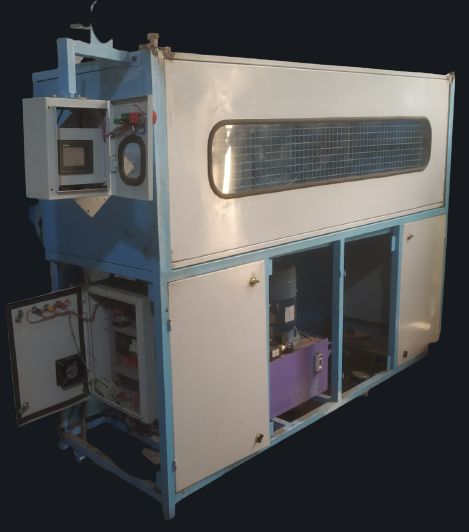
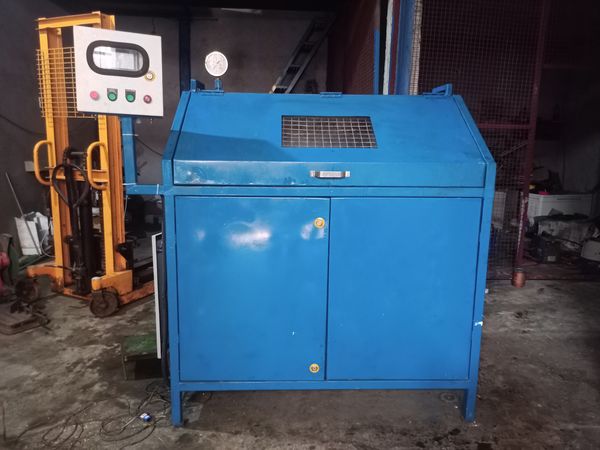
A water leak testing machine — also called a submersion, dunk tank or bubble leak test machine — pressurises your component with air, lowers it into a tank of water, and holds it there while an operator watches. Air escaping from a crack, a porous casting or a bad weld comes up as a visible stream of bubbles, at the exact spot that is failing.
It is the oldest method still in daily use, and it survives for a reason no instrument has replaced: it tells you where. A pressure decay reading says the part leaks somewhere. A submersion test points at the porosity in the boss, the pinhole in the weld, or the seam that opened during casting — which is the information your process engineer actually needs to stop it happening again.
Where it earns its place: next to an air station, not instead of it. Screen every part on air for speed, then send only the failures to water to find out why. Many of the lines we have built work exactly this way.
A tank of water and a compressor is not a machine. What turns it into a repeatable test is the pneumatics, the timing and the record — and that is what we design around your part.
We supply water leak testing machines for pressure die cast housings, gearbox casings, pump bodies, radiators and intercoolers, fuel tanks, welded fabrications, tubular assemblies, cooler bodies, motor end shields, cylinder heads and moulded plastic tanks. Anywhere porosity or weld quality is the failure mode, submersion finds it faster than an argument about instrument settings.
Where the part must stay dry, or the cycle time is too tight for a tank, an air leak testing machine is the right answer instead. Where the working pressure is high, use a hydraulic leak testing machine. Our leak testing machine overview compares all the methods side by side.
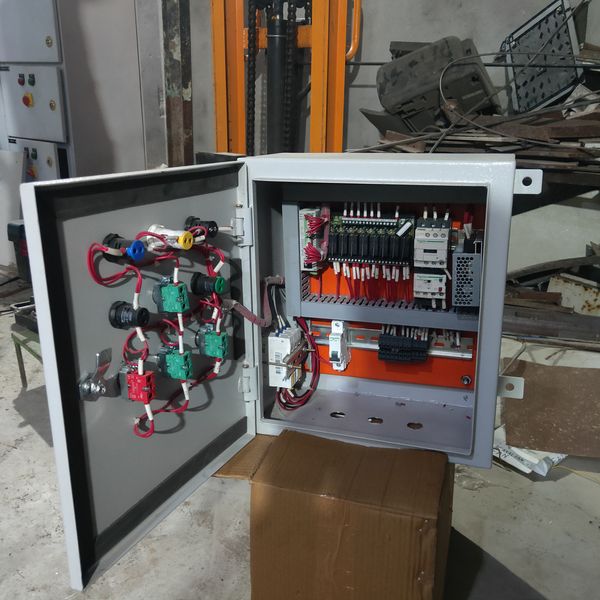
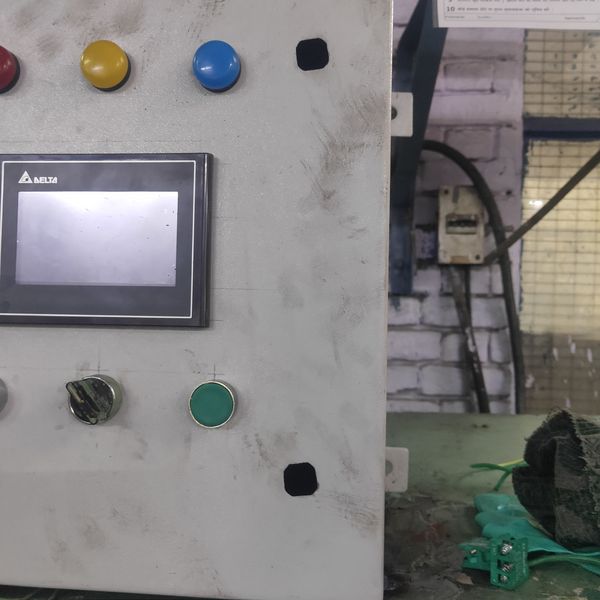
The verdict may come from the operator's eyes, but the cycle, the pressure, the dwell time and the result are all controlled and recorded by the PLC panel we build in the same workshop.
The PLC holds the part submerged for the full observation time. The lift will not rise early because the shift is running late.
Part number, pressure, dwell time, operator ID, verdict and timestamp written for every cycle.
Underwater lighting and a dark backdrop. A fine stream of bubbles is easy to miss in a badly lit tank.
Failed parts need a supervisor login to release, and the rejection reason is recorded against the part.
Pressure relief, guarded lowering, two-hand start where needed, and E-stop wired to a safety relay.
Filtration, level control, drain and rust inhibitor dosing, so parts come out clean and the tank does not become a maintenance job.
Photographs from our Faridabad workshop and from customer installations.
water-leak-test-tank.jpgSubmersion tank in operationwater-leak-test-machine.jpgFull station, front viewwater-leak-test-bubbles.jpgBubbles at leak pointwater-leak-test-fixture.jpgSealing fixture and lowering armwater-leak-test-panel.jpgPLC control panelwater-leak-test-hmi.jpgHMI verdict screenAll of it is agreed and written on the GA drawing before we cut steel — tank size in particular, because it is the one thing that cannot be changed later.
| Parameter | What it covers | Fixed at |
|---|---|---|
| Tank size | Sized to your largest component plus handling clearance | Enquiry |
| Test pressure | Set to your component and customer standard | Enquiry |
| Dwell time | Observation time enforced by the PLC | Drawing approval |
| Lowering | Pneumatic cylinder, guided, fixed depth and speed | Drawing approval |
| Fixture and sealing | Part-specific, poka-yoke, quick-change where needed | Drawing approval |
| Lighting | Underwater illumination and dark backdrop | GA approval |
| Water system | Filtration, level control, drain, rust inhibition | GA approval |
| Control system | PLC and HMI, recipe per part number, verdict logging | GA approval |
| Safety | Guarding, pressure relief, interlocks, E-stop circuit | Always |
On most of the lines we have built, the two machines work together. The air leak testing machine screens every part in a few seconds and passes the good ones straight through. Only the failures go to the water tank, where the leak is located and the finding fed back to the foundry or the welding bay.
The result is a line that keeps its cycle time and still learns something from every reject, instead of throwing parts in a bin marked leaker and hoping the next batch is better. Where it helps, we link both stations through one PLC so a part cannot skip a step.
It measures a different thing. Air pressure decay gives you a number in mbar per second that you can log and trend. Water submersion gives you a yes or no and the exact location of the leak. For fine leak rates air is more sensitive; for finding porosity and weld defects, water wins every time.
Not if the water system is designed properly. We fit filtration, level control and rust inhibitor dosing, and where the part demands it, a blow-off station at the exit. Neglect the water and any dunk tank becomes a rust problem within weeks.
The PLC controls the lowering and holds the part down for the full dwell time. The lift will not rise early. Dwell time, part number, operator ID and verdict are all recorded for each cycle.
The lowering, pressurising, timing and logging are automatic. The observation is human by definition, which is the point of the method — but we have built stations with cameras and overhead viewing screens where the tank is awkward to see into.
We size the tank around your largest component with handling clearance. Tell us the biggest part you will ever test, not just the current one, because the tank is the one thing that cannot be enlarged afterwards.
Yes. FutureTech Electricals started as a control panel manufacturer in Faridabad, and the panel is built and ferruled in the same workshop as the machine.
Yes — Delhi NCR, Gurugram, Manesar, Bhiwadi, Ghaziabad, Noida and across India, commissioned by our own engineers.
Share the drawing or a photo on WhatsApp and we will come back with a method, a cycle time and a price.
Please add a phone number or an email so we can reply.
Only a phone number or email is needed. Everything else is optional — the WhatsApp chat opens with your requirement already written, so you can add the rest there.
Want to know more, or ask anything about Water Leak Testing Machine? We reply fast on WhatsApp