Every tube bend is really two numbers — the angle you commanded and the angle you got. We build hydraulic pipe bending machines in Faridabad with PLC angle control, springback compensation stored per material and per tube size, and multi-bend recipes so the second piece matches the first.
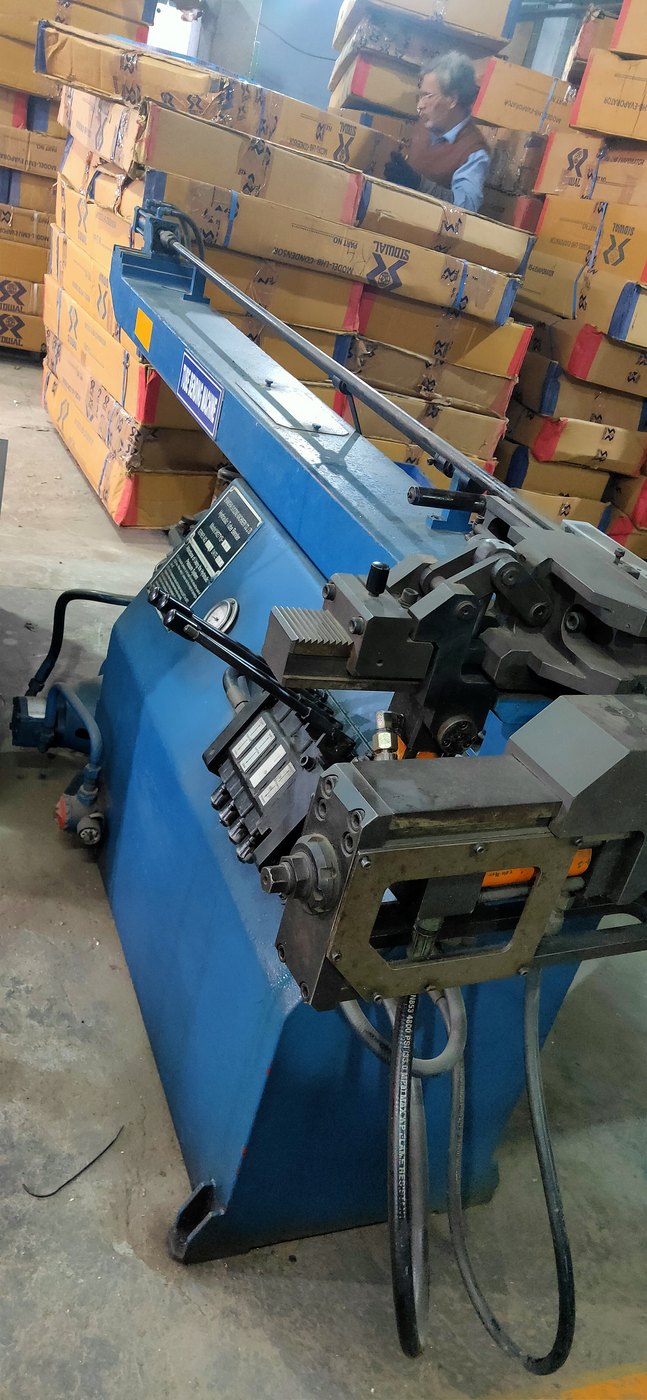
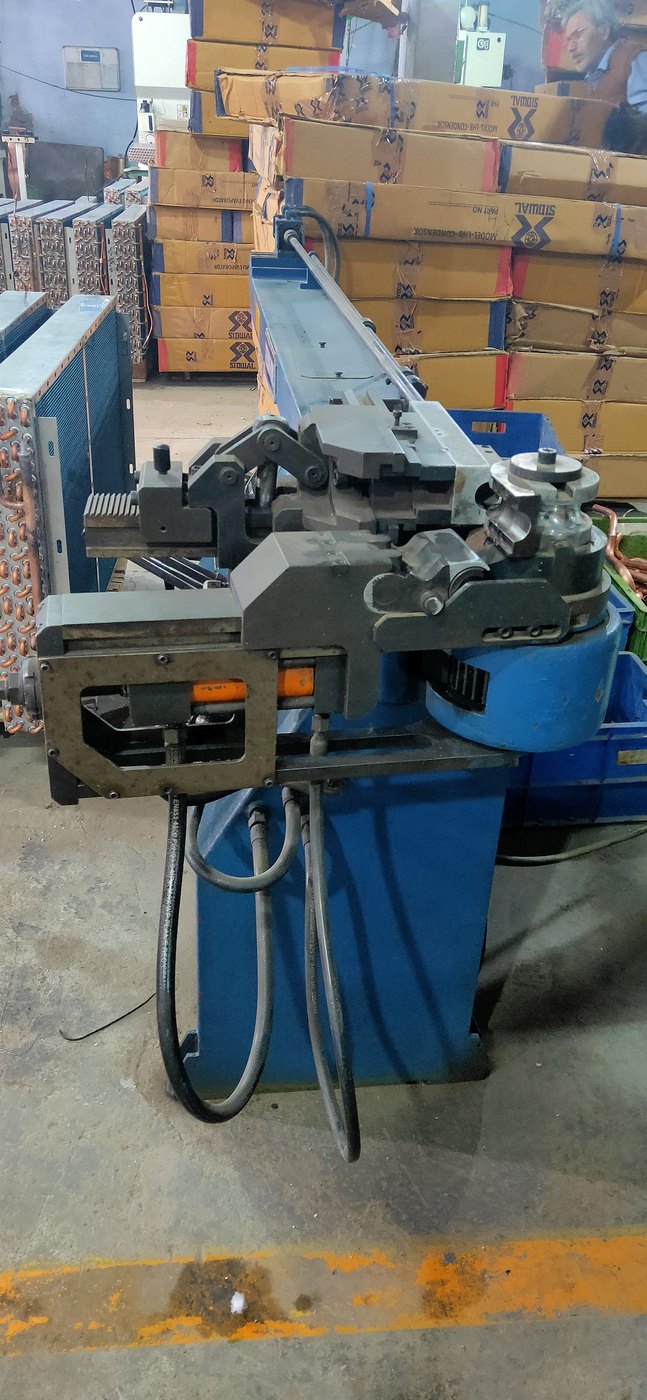
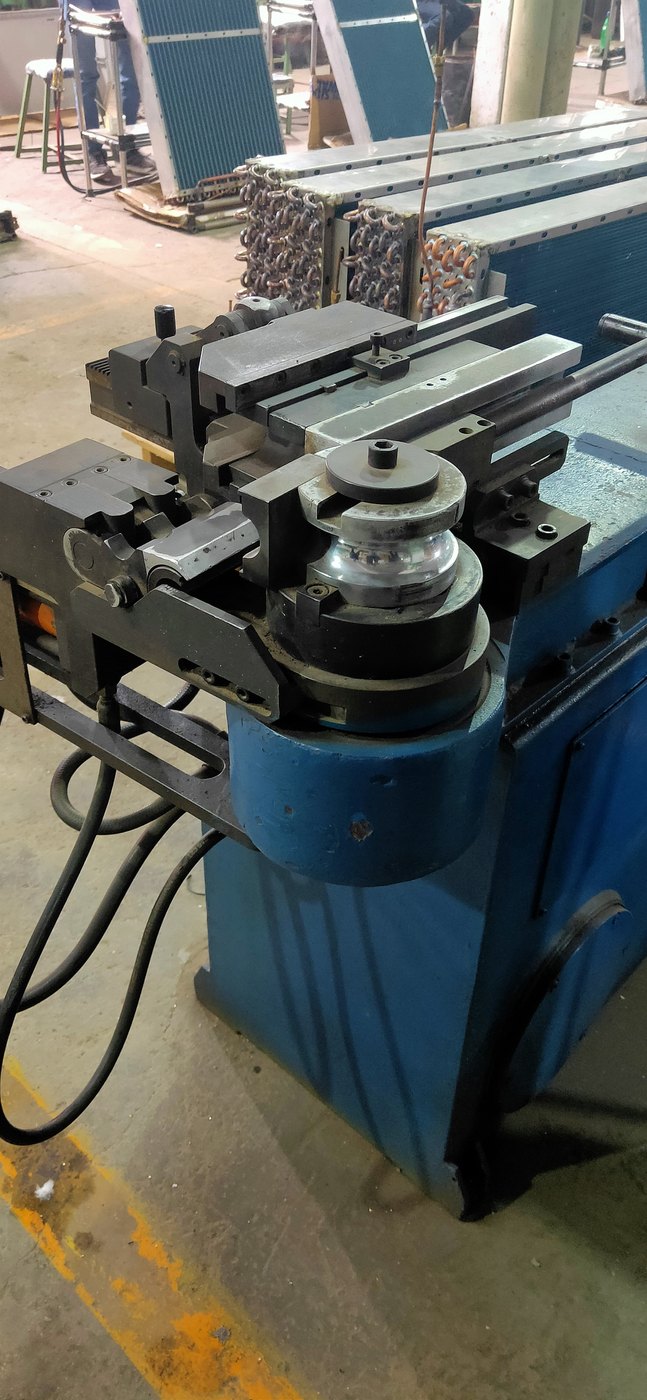
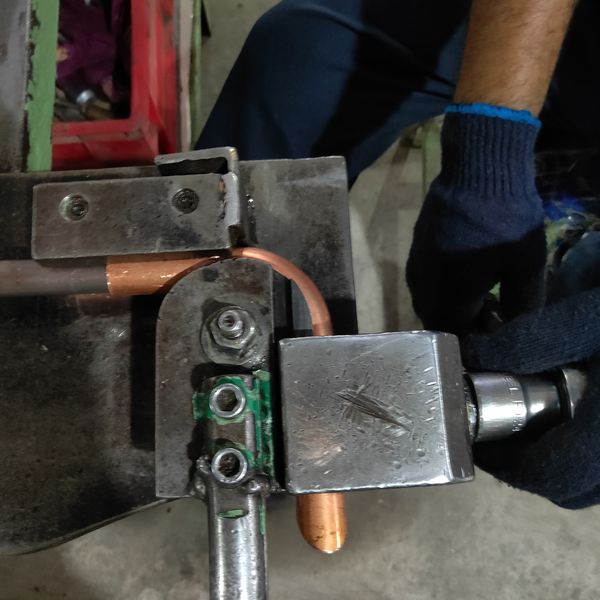
A hydraulic pipe bending machine clamps a tube against a bend die and draws it round to an angle. The difficulty is that steel does not stay where you put it. Release the clamp and the tube springs back — by a few degrees for mild steel, more for stainless, and by an amount that changes with wall thickness, tube diameter, bend radius and even the batch of material.
Bend to 90° and you will get 86° or 87°. Every bender in the world faces this. The difference between a machine that produces repeatable parts and one that produces an argument is whether the springback is guessed by the operator each time or stored in the machine per material and per tube size.
What that means in practice: with compensation stored, you type the angle you want on the drawing and the machine over-bends by the right amount by itself. Without it, the first three tubes of every batch are setup scrap and the fourth is a judgement call.
Angle is measured by encoder and controlled to the degree. Springback compensation is stored per material and per tube specification, so the operator enters the drawing angle rather than a corrected one. Multi-bend parts are stored as recipes with angle, rotation and distance-between-bends for each bend in the sequence, and the HMI prompts the operator through them in order — which is what stops bend three being made before bend two on a Friday afternoon.
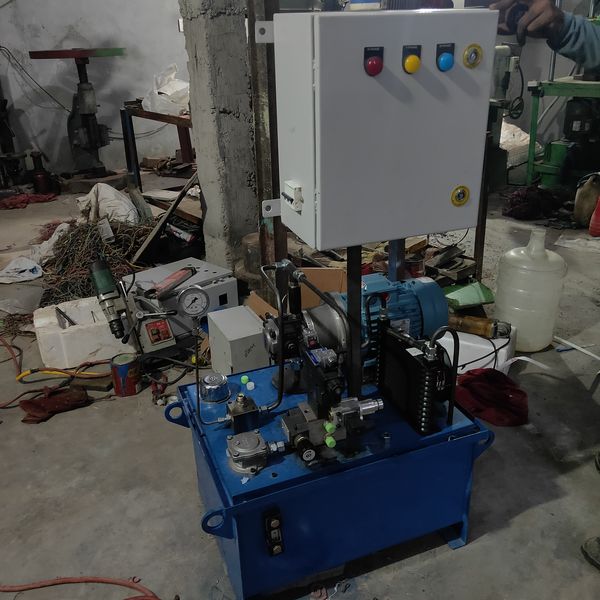
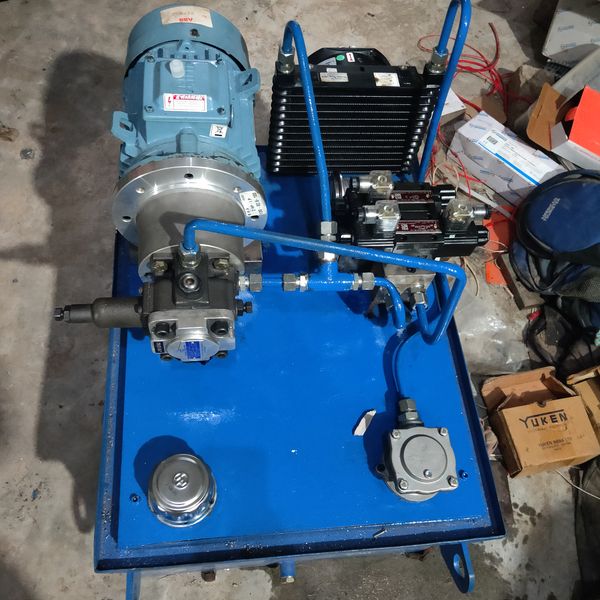
The hydraulics are driven by a power pack we build ourselves, sized for the bending force and duty cycle rather than picked from stock. Where the finished assembly must also be pressure tested, we build the matching hydraulic test rig or hose pipe testing machine alongside it.
Automotive tube lines — brake pipes, fuel lines, exhaust and EGR tubes, seat and chassis frames. Hydraulic and pneumatic pipe fabrication. Heat exchanger and boiler tube work. Furniture, handles and railings. Anywhere a batch of identical bent tubes has to come out identical.
Angle control, springback compensation and multi-bend sequencing all live in a PLC panel built and ferruled in our own Faridabad workshop.
Bend angle measured and controlled to the degree, rather than run up to a stop and hoped for.
Springback held per material and tube size. The operator enters the drawing angle; the machine does the arithmetic.
Angle, rotation and distance for every bend stored per part, with the HMI prompting the operator in order.
Parts counted per recipe and per shift, with tooling change reminders based on actual bends made.
Pump, valve bank and cooling sized for your bending force and cycle rate by our own hydraulics team.
Guarded bending zone, two-hand start where needed, and E-stop wired through a safety relay.
Photographs from our Faridabad workshop and from customer installations.
pipe-bending-machine.jpgComplete bending machinepipe-bending-tooling.jpgBend die and clamp toolingpipe-bending-hmi.jpgHMI with angle and recipepipe-bending-mandrel.jpgMandrel assemblypipe-bending-panel.jpgPLC control panelpipe-bending-samples.jpgBent tube samplesTube specification decides the tooling, and tooling cannot be changed later. Each of these is agreed on the GA drawing before manufacturing.
| Parameter | What it covers | Fixed at |
|---|---|---|
| Tube range | Diameter and wall thickness range to be handled | Enquiry |
| Material | Mild steel, stainless, aluminium, copper — affects springback | Enquiry |
| Bend radius | Radii required, and whether multi-stack tooling is needed | Enquiry |
| Method | Rotary draw, mandrel or compression bending | Drawing approval |
| Maximum angle | Bend angle range including over-bend allowance | Drawing approval |
| Bends per part | Number of bends, rotation between them, distances | Drawing approval |
| Springback data | Established during trials, stored per material and size | Trial run |
| Control | PLC and HMI make, recipe structure, counters | GA approval |
| Safety | Guarding, two-hand start, interlocks, E-stop circuit | Always |
Springback cannot be calculated reliably from a table — it depends on your actual material, from your actual supplier. So during trials we bend your tube, measure what came out, and store the correction against that material and size. Do it once at commissioning and it is right for every batch afterwards.
If you later change tube supplier or specification, the correction is a number on the HMI, not a service call.
Springback. The tube elastically recovers when the clamp releases, so a 90° command gives 86° or 87°. The amount depends on material, wall thickness, diameter and bend radius. Our machines store the correction per material and tube size, so you enter the drawing angle and the machine over-bends by the right amount.
When the wall is thin and the radius is tight — without internal support the tube flattens on the outside of the bend and wrinkles on the inside. As a rough guide, thin-wall tube at tight radii needs one; heavier wall at generous radii usually does not. Send us the tube spec and the radius and we will tell you.
Yes, with tooling change. Bend dies, clamp dies and pressure dies are size-specific, so the machine is built for a range and supplied with tooling for the sizes you run. Multi-stack tooling lets you keep several radii mounted at once.
Yes. Angle, rotation and distance between bends are stored as a recipe and the HMI prompts the operator through the sequence in order, with a counter for each part.
Bend a sample, measure it, and update the springback figure on the HMI. It is a number, not a service visit.
Yes, it is one of our own product lines, sized for the bending force and duty cycle rather than picked off a shelf.
Yes — Delhi NCR, Gurugram, Manesar, Bhiwadi, Ghaziabad, Noida and across India, installed and commissioned by our own engineers.
Share the drawing or a photo on WhatsApp and we will come back with a method, a cycle time and a price.
Please add a phone number or an email so we can reply.
Only a phone number or email is needed. Everything else is optional — the WhatsApp chat opens with your requirement already written, so you can add the rest there.
Want to know more, or ask anything about Hydraulic Pipe Bending Machine? We reply fast on WhatsApp