Tapping is the operation where a small mistake becomes a scrapped component that already has hours of value in it. Our auto tapping machines watch torque through every revolution, reverse cleanly at depth, and stop the moment a tap starts to fail — so the damage ends at one thread rather than one casting.
Free site visit and quotation across Faridabad, Ballabgarh, Palwal, Gurugram, Delhi NCR, Noida, Ghaziabad and Manesar. Looking for a tapping machine manufacturer near you? Call +91 90154 04168 — same-day reply, or send your drawing on WhatsApp.
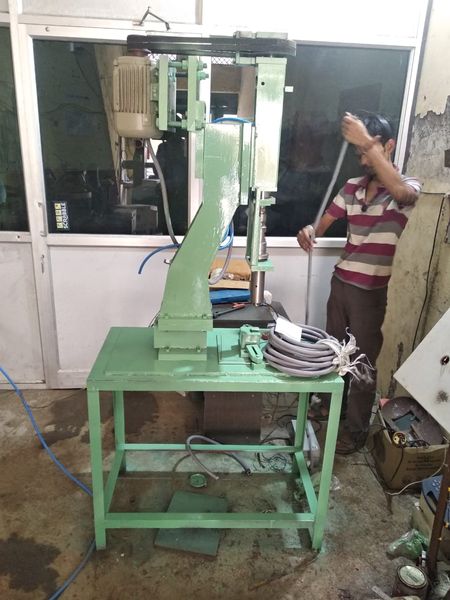
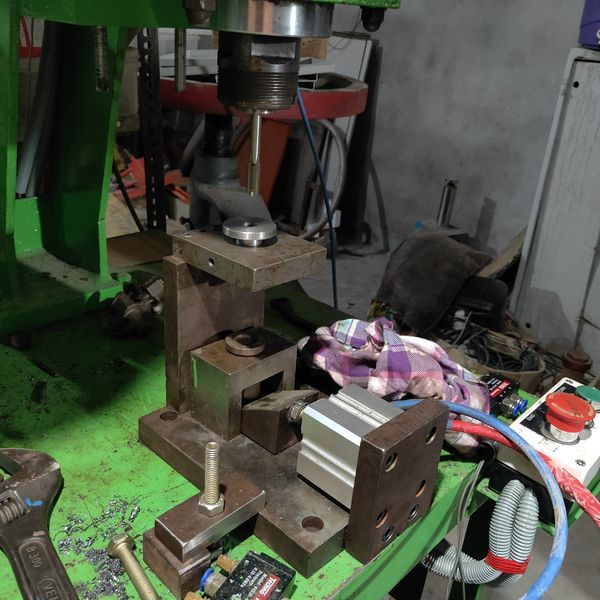
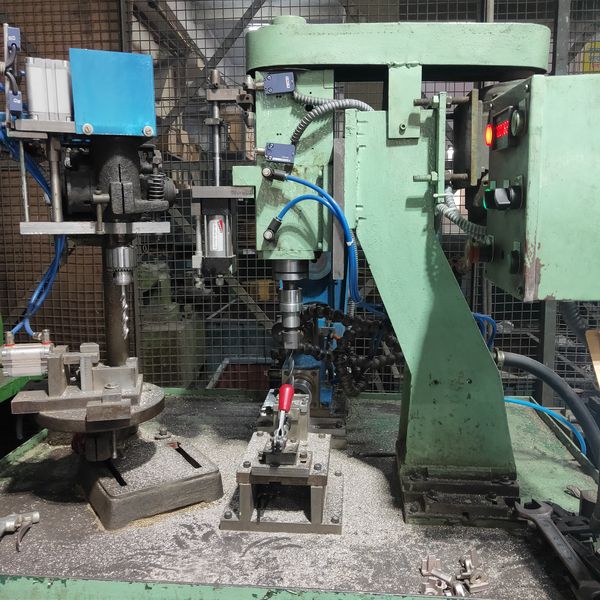
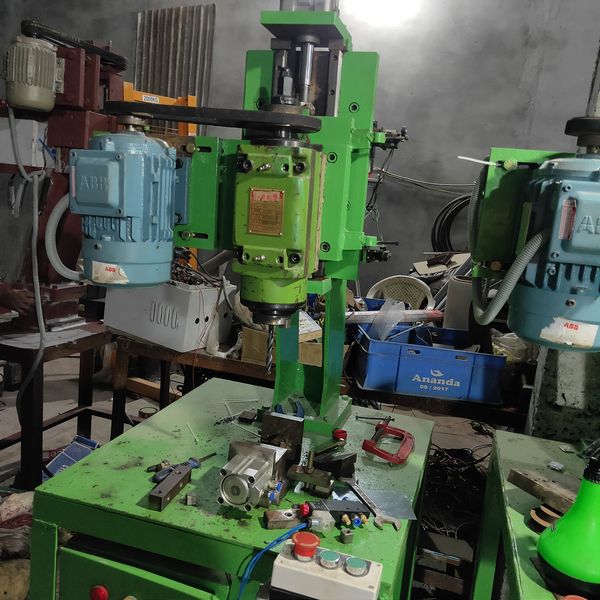
Drilling removes material and stops. Tapping engages the workpiece along a helix, cuts a thread, and then has to come back out through the thread it just made. That extra requirement is what makes it the fussiest operation on most machining lines — and the one where a failure costs the most, because tapping is usually the last thing done to a component that already has hours of work in it.
A tapping machine built for the job controls three things a drill press cannot: the synchronisation between rotation and feed, the torque the tap is allowed to see, and a clean powered reversal at depth. Get those right and taps last. Get them wrong and you spend your week extracting broken taps from good castings.
The cost is never the tap. It is the casting it broke inside — and the hour someone spends trying to get it out without ruining the part further.
A healthy thread has a recognisable torque signature: a rise as the tap enters and the lead taper engages, a steady plateau through the full-form section, then a fall as it reverses out. The animation above shows exactly that curve running inside its accept band.
Departures from it are diagnostic, and the machine acts on them within a revolution:
Most tapping trouble is not the tap. It is the pilot hole being drilled at the wrong size or drifting as the drill wears, the lead-in chamfer missing so the tap starts off-square, the coolant not reaching the cutting edge, or the swarf having nowhere to go in a blind hole. We design the drilling station, the coolant and the chip clearance as one job with the tapping, which is why a combined station usually outperforms two separate machines bought from two suppliers.
See also our drilling and tapping SPM overview for how these stations are combined.
Torque monitoring, depth control, reversal and tool life all run from a panel designed, built and ferruled in our own Faridabad workshop.
The trace is compared to a band learned from your own good threads, not to a number from a table.
Torque collapse is unmistakable. The cycle aborts, the part is flagged, and nothing downstream sees a half-cut thread.
Encoder-controlled depth with programmed dwell and powered reversal, so blind holes are tapped to size without bottoming.
Threads counted per tap with change reminders, and the torque trend showing wear before it becomes a breakage.
Size, pitch, depth, speed and torque band stored per part number, with tooling ID so the wrong tap cannot run.
Guarding, two-hand start where needed, and E-stop through a safety relay rather than a PLC output.
Photographs from our Faridabad workshop and from customer installations.
tapping-machine.jpgComplete tapping machinetapping-machine-spindle.jpgTapping head and holdertapping-machine-hmi.jpgHMI torque trace screentapping-machine-fixture.jpgFixture and clampingtapping-machine-panel.jpgPLC control paneltapping-machine-component.jpgTapped componentThread specification decides tooling, speeds and torque limits, so it is all agreed and drawn before manufacturing.
| Parameter | What it covers | Fixed at |
|---|---|---|
| Thread size and pitch | Every thread on the part, with class of fit | Enquiry |
| Hole type | Through or blind, and depth of full thread required | Enquiry |
| Material | Cast iron, aluminium, steel — sets speed and torque band | Enquiry |
| Number of spindles | Single or multi, from cycle time and thread positions | Drawing approval |
| Tapping method | Rigid or tension-compression holder | Drawing approval |
| Torque band | Learned from good threads during trials | Trial run |
| Coolant | Delivery to the cutting edge, tank and filtration | GA approval |
| Swarf clearance | Especially for blind holes — peck cycle if required | GA approval |
| Safety | Guarding, interlocks, two-hand start, E-stop circuit | Always |
Torque limits from a handbook are a starting point, not an answer — your material, your pilot hole and your coolant all move the numbers. At trial we tap a batch of good components to establish the real band, then deliberately run the failures you see: a worn tap, an undersize pilot, a hole with swarf left in it. Each one must be caught before the station is signed off.
That trial is part of the buy-off, because torque monitoring that has never been tested against a real failure is a specification line, not a safeguard.
Torque collapses. A tap that has snapped takes almost no torque, and that shows up within a revolution. The cycle aborts immediately and the part is flagged, so a component with a half-cut thread never reaches assembly.
Rigid tapping synchronises rotation and feed electronically and gives the best thread form and pitch accuracy, but needs a rigid machine and good hole preparation. A tension-compression holder absorbs small synchronisation errors and is kinder to taps in less rigid setups. We advise based on your thread class and the machine layout.
Usually swarf. In a blind hole the chips have nowhere to go and pack in ahead of the tap. A peck cycle that retracts to clear, correct flute geometry and coolant that actually reaches the bottom of the hole fix it in most cases.
Yes. Size, pitch, depth, speed and torque band are stored as recipes per part number, with tooling ID checks so the wrong tap cannot run against the selected part.
Yes, and it is usually the better answer. The part is fixtured once and indexes between drilling and tapping heads, which removes the re-location error that causes most off-square tap starts.
Yes, against the part number with operator, tool and timestamp. With SCADA added, the trend across a shift shows tap wear well before it becomes a breakage.
Yes — Delhi NCR, Gurugram, Manesar, Bhiwadi, Ghaziabad, Noida and across India, installed and commissioned by our own engineers.
Share the drawing or a photo on WhatsApp and we will come back with a method, a cycle time and a price.
Please add a phone number or an email so we can reply.
Only a phone number or email is needed. Everything else is optional — the WhatsApp chat opens with your requirement already written, so you can add the rest there.
Want to know more, or ask anything about Tapping Machine? We reply fast on WhatsApp