Most of these come up on the first phone call, and most have a straight answer that nobody bothers to write down. So we wrote them down. No sales copy — if the honest answer is that you do not need the thing we sell, that is what it says.
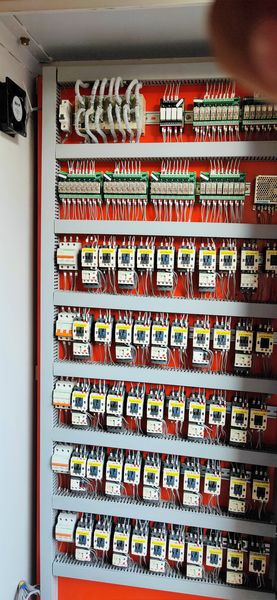
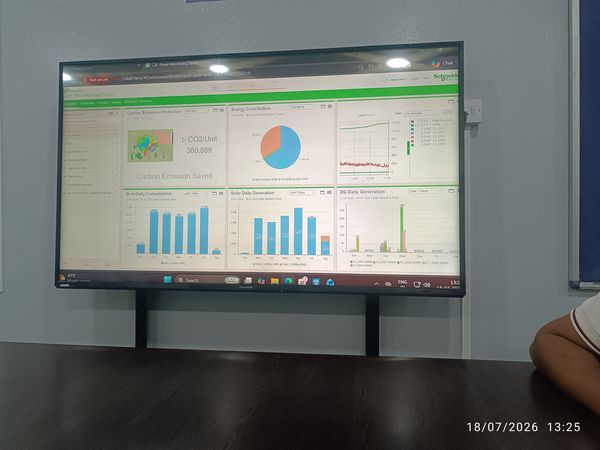
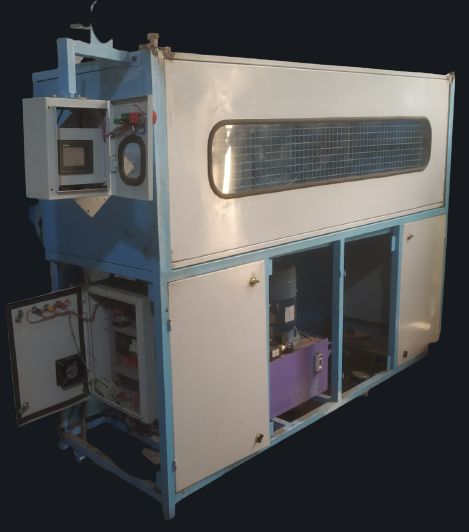
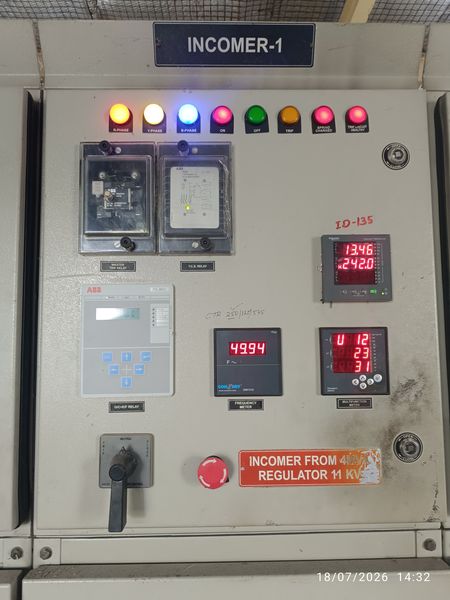
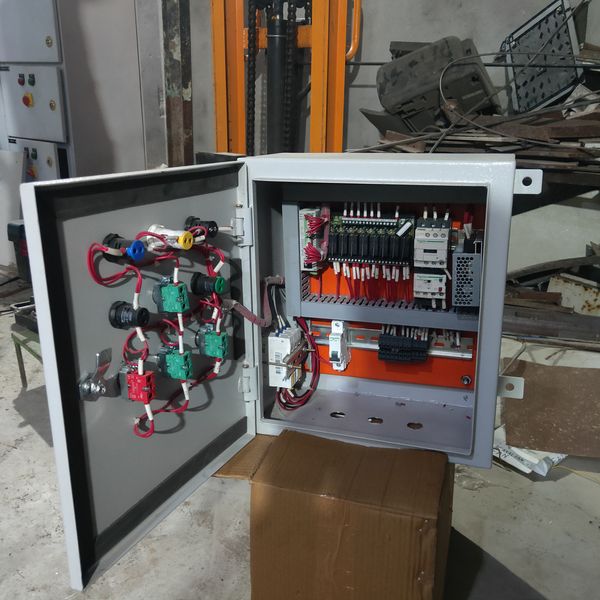
A PCC — power control centre sits at the incoming end and distributes power. It takes the supply from the transformer or the main breaker and feeds outgoing circuits, so it is built around busbars sized for the full incoming current and breakers for each outgoing feeder. An MCC — motor control centre sits downstream and starts and protects motors, so it is built around starter feeders in modules, each with its own contactor, overload and isolation.
The short version: PCC distributes power, MCC controls motors. A plant usually has one PCC and several MCCs. PCC panels → · MCC panels →
Inductive loads — motors, welding sets, induction furnaces — draw reactive power that does no useful work but is still carried by the supply. That drags your power factor down, and DISCOMs penalise a poor power factor and often reward a good one. An APFC panel switches capacitor banks in and out automatically to keep the power factor near unity.
The saving shows up in two places: the penalty disappears, and your demand in kVA falls for the same kW of useful work, which reduces demand charges. Whether it is worth it depends on your current power factor and your tariff — send us a recent bill and we will do the arithmetic before you commit. APFC panels →
If the load varies, almost certainly. For pumps and fans, power follows roughly the cube of speed — running at 80% speed uses close to half the power. Most fans and pumps are sized for a peak that happens rarely and then run at full speed permanently because a direct starter has no other setting.
If the load is constant and the motor runs flat out all day, a VFD saves nothing on energy, though it still gives soft starting and better control. Honest answer: for a constant-load conveyor, probably not. For an AHU fan or a pump on varying demand, yes. VFD panels →
Because in five years somebody will open it with a fault, and every wire will look the same. Ferrules mean any core can be traced to the drawing in seconds instead of being buzzed out one at a time. The extra cost is small and the payback comes the first time the panel is worked on.
It lets two or more diesel generators run in parallel, sharing load, and lets them come on and off without a break in supply. Without synchronising, transferring load means a gap. For plants where a gap is expensive — process lines, hospitals, data rooms — that gap is exactly what you are paying to avoid. DG synchronizing panels →
Air pressure decay gives a number you can log and defend, and it is faster and dry. Water submersion gives a visual verdict people trust and shows you where the leak is, which is what your process engineer needs to stop it happening again.
Many lines end up with both: air screens every part quickly, and only the failures go to water so the leak can be located. Compare leak testing methods →
Because they are expanding, not leaking. Pressure decay assumes the internal volume stays constant. A plastic or composite part grows under pressure, the volume increases and pressure falls — which the machine reads as a leak. The fix is a longer settle time before measurement, lower test pressure, gentler clamping, and often differential testing against a master of the same material. Testing flexible components →
Pressure decay watches the absolute pressure inside your part and looks for it falling. Differential compares your part against a sealed master of similar volume and measures only the difference, which cancels out temperature drift. Decay suits ordinary limits; differential is what you need when the reject limit is tight or the parts are still warm from machining. Air leak testing →
Safety. Compressed air at high pressure stores enormous energy and a part that bursts becomes shrapnel. Liquid is nearly incompressible, so the same failure releases almost nothing — the part splits and pressure collapses. That is why pressure codes specify liquid, and why our high-pressure rigs use oil or water behind an enclosure. Hydraulic leak testing →
Because sealing is not the acceptance criterion — restriction is. A silencer with a blocked or misplaced baffle is perfectly sealed and completely wrong. That needs a flow test measuring back pressure at a given flow, with an upper and a lower limit, because too free-flowing usually means the internals are missing. Air flow testing →
A special purpose machine is built for one job on one component, rather than being a general-purpose machine set up for a task. You need one when no catalogue machine does exactly what your part requires, or when the cycle time and repeatability you need cannot be achieved by an operator with standard equipment. SPM overview →
Missing washers and components, cross-threaded or off-square bolts, cracked or soft parts, wrong variants, short-fed assemblies and worn tooling. None of these necessarily breaks a force limit or a position limit, but all of them change the shape of the curve — and the machine judges the shape against an envelope learned from your own good parts. Press monitoring with SCADA →
The load or torque signature changes instantly. A broken tool takes almost no torque; a blunt one takes too much. Either way the cycle aborts within a revolution and the part is flagged, so a component with a half-cut thread never reaches assembly. Tapping machines →
It is rarely volume alone. The number that usually decides it is what one escaped defect costs you at the customer end, including recall risk — not the labour saving. Tell us your parts per hour, your operator cost and your escape cost, and the answer is usually obvious within a few minutes. Automated testing SPM →
Whichever your maintenance team already knows and your spares cupboard already stocks. A technically superior controller that nobody on site can service is worse than an ordinary one they can. Where there is no existing standard, we recommend based on the application and local support. PLC and SCADA →
The castings and the ways decide it. If the bed is sound and way wear is within reclaimable limits, retrofitting almost always beats buying new — a fraction of the cost, delivered in weeks, on a machine your operators already know. If it has been badly crashed, run dry for years or has a cracked casting, it is not a candidate and we will tell you so. CNC retrofitting →
You can, and it produces a machine with a nice new screen and the same old accuracy problem. Backlash and way wear are not things a servo can correct if the feedback cannot see them. We survey both sides and quote both, and if only the electronics need doing we say that too.
Because the panels and inverter — the standardised part everyone compares — are not what varies. The structure, the roof type, the cable run and the interconnection do, and none of it can be assessed without a site visit. A firm number on a first call is a number that gets revised later. What drives solar cost →
Not with a plain on-grid inverter. Anti-islanding protection makes it shut down the instant the grid fails, so it cannot energise a line a lineman believes is dead. Running loads through an outage needs a hybrid inverter with battery, which costs meaningfully more — and is one of the commonest reasons two quotations differ. Net metering explained →
It is capped in relation to your sanctioned load or contract demand, with the percentage set by state policy — not by how much roof you have. Check the limit first, then size the plant. Industrial solar →
These are the questions that come up most often. If yours is not here, it is probably a better question — send it across.
Send the drawing, the part photo or just the question. We answer technical questions whether or not there is an order in it.
Faridabad, Sector 23. Call ahead and we will show you whatever is being built that week.
If you do not need the thing, or a different method suits better, that is what you will be told.
Photographs from our Faridabad workshop and from customer installations.
workshop-wide.jpgOur workshop, Faridabadpanel-wiring-ferruling.jpgFerruled panel wiringleak-test-hmi.jpgLeak test HMIbolt-press-scada-graph.jpgPress force-displacement graphcnc-retrofit-after.jpgCNC after retrofitsolar-rooftop-plant.jpgRooftop solar plantWhere to go next, depending on what brought you here.
| If you are looking at | Start here |
|---|---|
| A panel for a plant or machine | MCC, PCC, APFC, PLC and LT panel pages |
| Proving a part seals | Leak testing machine overview |
| Proving an assembly was made right | Bolt press with SCADA monitoring |
| A hole pattern or threads | Drilling and tapping SPM |
| An idle CNC machine | CNC retrofitting and refurbishment |
| Cutting an electricity bill | Industrial solar and APFC panels |
| A building services panel | AHU, fire fighting, lift and car parking panels |
Because the same eight questions arrive every week, usually from people who have been given a quotation and no explanation. A buyer who understands why one quote is cheaper is a better customer than one who simply picks the lowest number — and is far less likely to be disappointed later.
If your question is not here, send it. We answer technical questions whether or not there is an order attached, and the good ones end up on this page.
A PCC, or power control centre, distributes incoming power to outgoing feeders. An MCC, or motor control centre, starts and protects motors through starter modules. A plant usually has one PCC and several MCCs.
It removes the low power factor penalty on your bill and reduces demand in kVA for the same useful kW, which lowers demand charges. Whether it pays back depends on your current power factor and tariff, which we work out from a recent bill.
Air pressure decay gives a recordable number and is faster and dry. Water submersion gives a visual verdict and shows where the leak is. Many lines use air to screen and water to investigate failures.
They expand under pressure rather than leaking. The internal volume grows and pressure falls, which reads as a leak. Longer settle time, lower pressure, gentle clamping and differential testing against a master solve it.
If the bed casting is sound and way wear is reclaimable, yes — a retrofit costs a fraction of a new machine and delivers in weeks. If the machine has been crashed hard or run without lubrication for years, it is not a candidate.
Not a plain on-grid system. Anti-islanding protection shuts it down so it cannot energise a line a lineman thinks is dead. Running loads during an outage needs a hybrid inverter with battery.
If the load varies, usually yes — fan and pump power follows roughly the cube of speed. If the motor runs at constant full load all day, a VFD saves no energy, though it still offers soft starting and better control.
Missing components, cross-threaded or off-square bolts, cracked parts, wrong variants and worn tooling — failures that change the shape of the curve without breaking a simple force or position limit.
Share the drawing or a photo on WhatsApp and we will come back with a method, a cycle time and a price.
Please add a phone number or an email so we can reply.
Only a phone number or email is needed. Everything else is optional — the WhatsApp chat opens with your requirement already written, so you can add the rest there.
Want to know more, or ask anything about panels and machines? We reply fast on WhatsApp